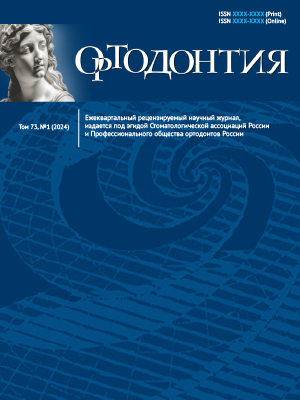
The scientific and useful publication Orthodontics is devoted to the organization and epidemiology of orthodontic therapy, as well as the diagnosis, treatment, and avoidance of dentofacial deformities and anomalies. Orthodontists from all over Russia come together for this one and only specialized publication. The journal's scientific concept focuses on rigorously proven facts from doctors' scientific and practical activities, and it includes the publication of contemporary research as well as the development and validation of innovative clinical and technical methods of diagnosis and treatment in orthodontics. Prominent Russian experts are required to peer review all published content. The journal offers reviews of national and international scientific literature, descriptions of clinical cases, and the findings of scientific clinical studies.
The journal invites submissions from scientists and physicians, both domestic and foreign, who practice orthodontics, maxillofacial surgery, prevention, and general dentistry. Reports from Russian and international conventions, congresses, and scientific conferences are published in the journal's "Events" section.
Premier-Orthodontics LLC and the Russian University of Medicine of the Russian Ministry of Health are the journal's founders. Published by the Professional Society of Orthodontists of Russia and the Dental Association of Russia.
Current issue
 Open Access
 Subscription or Fee Access
МЕТОДЫ ДИАГНОСТИКИ В ОРТОДОНТИИ
A collection of symptoms related to an incorrect or forced lower jaw position, including typical clinical, laboratory, and radiation diagnostic signs, can be referred to as the syn drome of forced position of the lower jaw. These signs help to distinguish between the various clinical forms of this disease.
One of the most complicated dentofacial abnormalities is mesial occlusion of the dental arches, which typically calls for an all-encompassing treatment strategy. In addition to morphological changes, the skeletal form of mesial occlusion is characterized by functional changes in the jaw and facial region, which need to be considered to prevent adverse effects. As a result, numerous researchers have examined this problem and offered scientifically supported recommendations for identifying functioning states both before and after treatment. The study's objective is to use electromyographic research data to compare the muscle state of individuals with mesial occlusion before and after combined treatment. Materials and Methods. Before and after combined treatment, we looked at 40 patients with skeletal mesial occlusion, ages 18 to 44. Additionally, a comparative study using normative data was carried out. In conclusion, electromyographic studies of patients between the ages of 18 and 44 showed that both before and after therapy, some markers had higher values than normal. This suggests that myodynamics has improved, but it also shows partial recovery. In order to provide conditions for the appropriate functioning of the stomatognathic system, electromyographic results must be taken into consideration while treating adult patients with skeletal types of mesial occlusion anomalies.
ЛЕЧЕНИЕ ЗУБОЧЕЛЮСТНО-ЛИЦЕВЫХ АНОМАЛИЙ И ДЕФОРМАЦИЙ
Relevance. Changes in periodontal tissues accompany orthodontic tooth movement, and if treatment planning and prognosis are not adequately comprehensive, problems may result. To increase the potential of orthodontics when there is insufficient bone and gingival volume, augmentation procedures are employed.
Purpose of the study: The goal of this study is to examine two-stage and one-stage approaches for increasing the periodontal phenotype.
Materials and Methods. PGingival recession depth, vestibula depth, attached gingival breadth, and colorimetric probes were used to assess patients' periodontal biotype. Axial and sagittal projections of CBCT were assessed at 3, 6, and 8 mm from the cementoenamel junctio n (CES).
Results. Following both procedures, the gingival biotype altered; the one-stage technique produced a medium gingival biotype, whereas the two-stage technique produced a thick gingival biotype. The thickness of the vestibular bone plate can expand by up to 2 mm at one stage and by up to 2 mm and more at two stages when bone volume and gingival thickness increase.
Conclusions. One-stage augmentation of gingiva and bone tissue can shorten treatment duration, minimize discomfort, and minimize problems.
Aim: To evaluate the literature and give clinical data on maxillary expansion combined with facemask therapy for the treatment of mesial occlusion in growing patients.
Materials and methods: This paper includes a clinical case analysis of a patient with mesial occlusion and maxillary constriction. The data included clinical examination findings, supplemental diagnostic information, and assessment of treatment progress during orthodontic intervention.
Results: A growing patient with mesial occlusion and maxillary width insufficiency had successful orthodontic treatment employing a mini-implant-supported Fit-free expander in conjunction with facemask therapy for maxillary expansion and sagittal growth modification. The case examination demonstrated favorable dynamics, showing that combined maxillary expansion and facemask therapy is helpful for early orthodontic correction of Class III malocclusion. This treatment method helps to avoid the formation of gnathic malocclusions, lowering the likelihood of future orthognathic surgery to normalize dental arch and jaw connections.
Conclusions: Early comprehensive orthodontic treatment of Class III malocclusion with maxillary expansion appliances and facemask therapy is an effective approach for stimulating maxillary growth, normalizing dental arch relationships, improving facial aesthetics, and preventing the progression of dentoalveolar anomalies.
A clinical instance of orthodontic treatment for a patient with dental alveolar elongation is presented in this paper. Methods of clinical and other examinations are outlined. The use of an orthodontic implant for nanoosteoperforation during the dental alveolar implantation stage is taken into consideration.
The study included 60 volunteers who were divided into two groups: those who used borneol toothpaste and those who used toothpaste with fluoride and calcium. Borneol toothpaste significantly reduced the SBI bleeding index, indicating a higher anti-inflammatory action. Increased transferrin and lysozyme levels indicate an increase in antioxidant and antibacterial mouth protection while using borneol toothpaste.
Adult patients with impacted teeth who use removable appliances in conjunction with braces and mini screws reduce the risk of root resorption while also i mproving both aesthetics and function.
The study's objective was to assess the use and treatment outcomes of our developed molar distalizer for distal molar displacement in patients between the ages of 12 and 15 at the initial stage of orthodontic treatment of the dentoalveolar form of distal occlusion. The procedure was then carried out in accordance with a standard protocol on a bracket system to normalize occlusion.